Posts Tagged ‘prayer’

Allowing Prayer to Happen to Us

Tuesday, November 9th, 2010

The majority of Americans report praying daily.  It is something however we rarely discuss.  (Americans tend to be profoundly spiritual AND profoundly private about it.)

In the future, we will be doing a small group program around prayer and/ or a one day workshop on prayer.  Prayer is a discipline – a part of the “work” that centers us in a spiritual life.

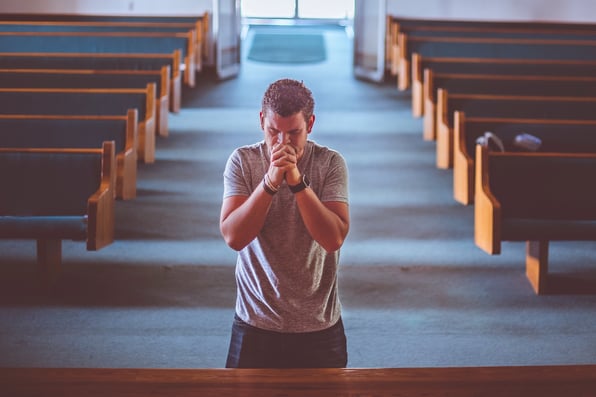
A part of growth is the shift from seeing prayer as something that we do, to seeing prayer as something that is done to us.  Prayer, from a New Church perspective, is as Emanuel Swedenborg noted “Conversation with God.”  It is conversation in which God’s response is often hope or comfort.

Prayer is not, as one author noted, an “intelligence briefing to God” though that is where we often start.  There is nothing wrong with this approach but it is only a start on the spiritual path.  At some time we must shift – moving away from one-way monologue in which we “report” our lives and requests to God to a movement towards a space in which we are quiet enough to “hear” God in the language that God speaks.

That takes discipline.  For me, such an approach works best when I arrive at prayer with a simple request to “know nothing.”  That seems to be a far healthier space for an obnoxious “doer” like myself.  From that space, at times, I can breath into a presence of God in which I think He can speak – not a speech of “today’s winning lottery number will be …” but a speech that includes words that settle deeply into my soul.  This past week for example that included ‘humanity’ and ‘What opens people to faith.’   The difference, restated, would be praying before a worship, early on a Sunday morning, “Lord help me to communicate ‘x’” vs. “Lord, what would you have me say today?”

Believe it or not, one prayer I find particularly effective – “Lord, take it all.  Leave me nothing but clear window.”

From there, prayer can happen to us – shining right on in.

I want to see God but I can’t

Thursday, September 2nd, 2010

Many people want to “see” God, experience God.  But the “seeing”, the experience, eludes them.  How then do we see God when our best efforts seem to leave us “without”, searching within what appears to b a vacuum?

To start, God simply “is.”  That means that God is something we awaken to vs. journey to.  We can often fall into the belief that certain actions will inevitably lead us to the experience of God.  I have not found that to be true.  My understanding is that we do those “actions’ – be they prayer, reading, meditation, service, worship – so that we are awake when God shows up. They do not create the experience.  They do however ensure that we are awake enough to know when the experience arrives.

Secondly, God’s presence is most often not of the “clouds parting” “trumpet blaring” variety.  The experiences tend to be far more gentle.  One author compared God’s voice to being as quiet as the beating of our own heart  (Try listening to your heart beating to get an idea of what that means).  While some individuals do experience the granduer of God in dramatic fashion – i.e. Martin Luther, Emanuel Swedenborg, Bill Wilson – most of us experience God in more muted yet not any less powerful ways.  That is why perhaps Jesus spoke of the presence of the Divine as the spirit, a word that can be translated “wind.”

One author’s point is one I have been thinking a great deal about recently.  Her perspective grew out of a endless prayers for the experience of Divine.  What she came to realize was that God’s answer to her longing was her longing.  It was that love, that compassion, that “pull” in her heart that bore great fruit in her life, a “pull” that might have moved her more in her life than any dramatic presentation of God.

If the pull to experience God is moving you forward in your life, that might just be the whole point.  That might just be the mercy and compassion of God at work in your life. Stay awake.  Keep doing the work.  God will show Himself in the ways He knows to be most important in light of goals that are eternal, not temporal.  Those are not often the most dramatic but they are the most transformative.